
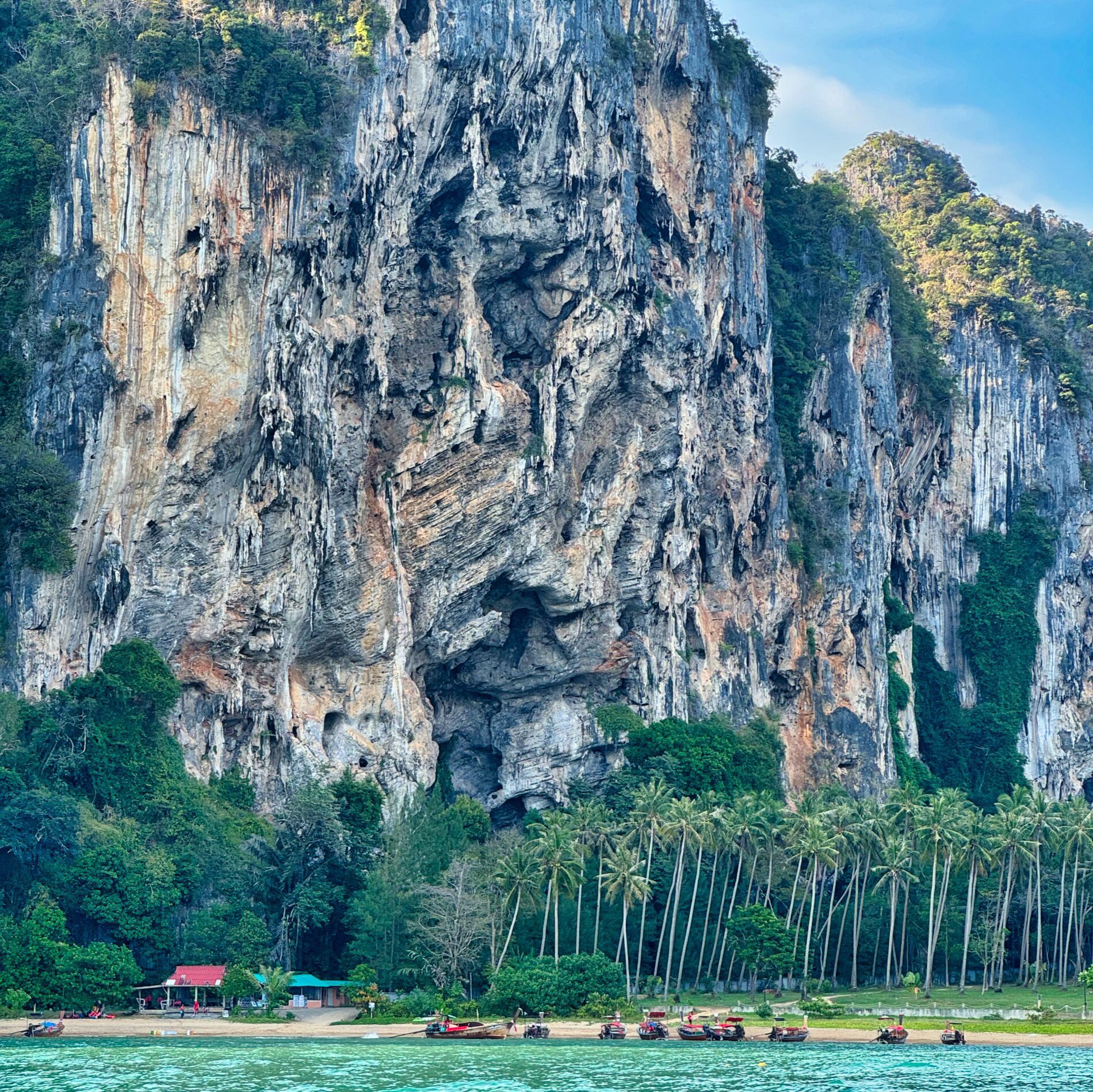
Heart of Darkness 6C+/7a
“Heart of Darkness” is one of the more popular and challenging multi-pitch routes in Tonsai. This heavily overhanging route consists of 5 pitches with a total height of about 120 meters and is located on Cat Wall, a crag that is less than 100 meters away from the Tonsai longtail ferry terminal.
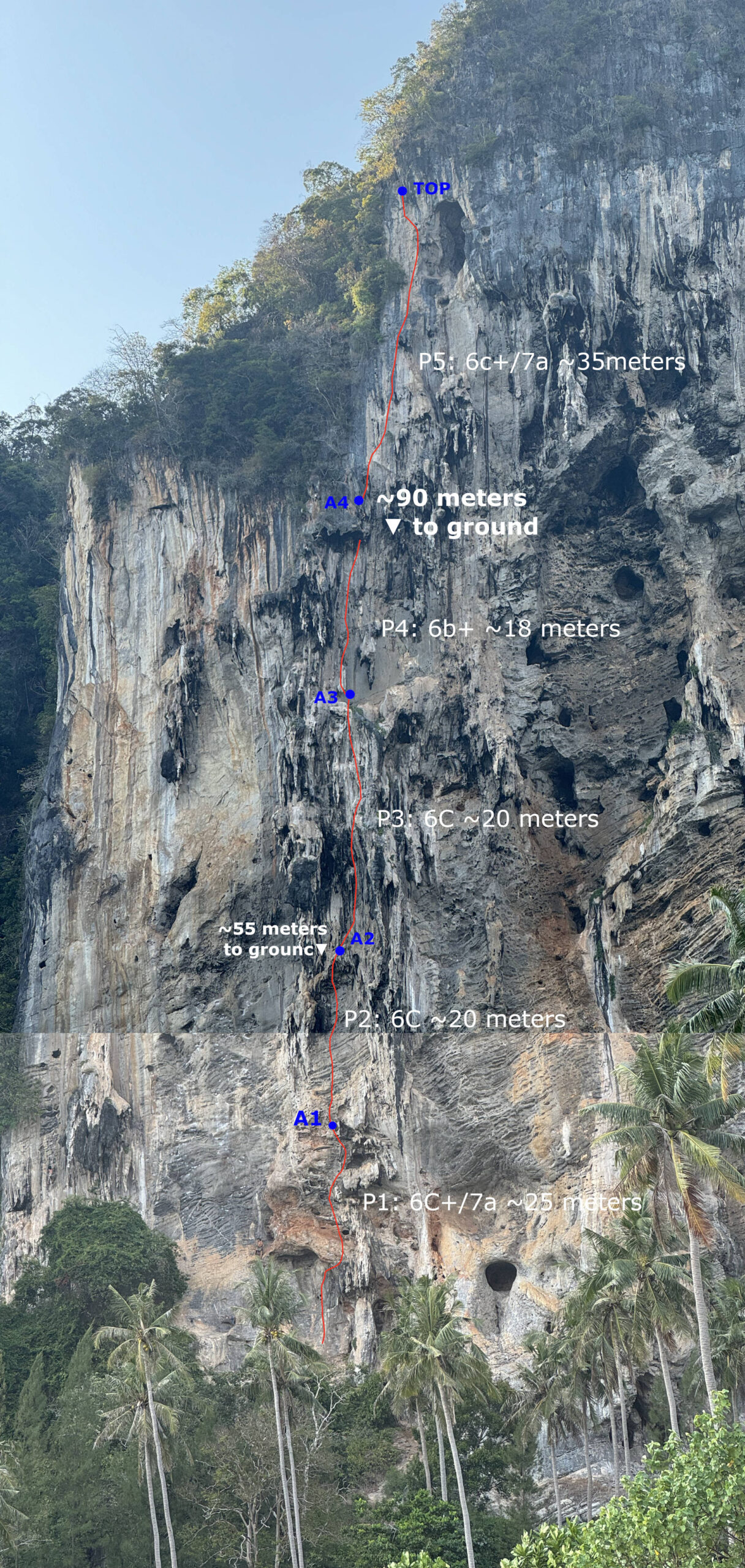
Pitch 1 (6c+/7a): is the most overhanging, athletic, and the hardest. Although most of the holds are jugs, they are also quite slippery, making it a bit challenging to cling to them, especially at high temperatures. The pitch is rated closer to 7a than 6c+.
Pitch 2 (6c): The second pitch has fairly good holds for the most part. A certain challenge is the end of the pitch.
Pitch 3 (6c): The third pitch is relatively long, with difficulties evenly distributed throughout its length.
Pitch 4 (6b+): The fourth, shorter pitch leads over slightly overhanging terrain to the “needle,” a constriction in the rock that climbers must squeeze through to reach the next belay station.
Pitch 5 (6c+/7a): The final, fifth pitch is definitely less overhanging than the previous pitches. The route becomes more technical and requires good finger endurance.
Access:
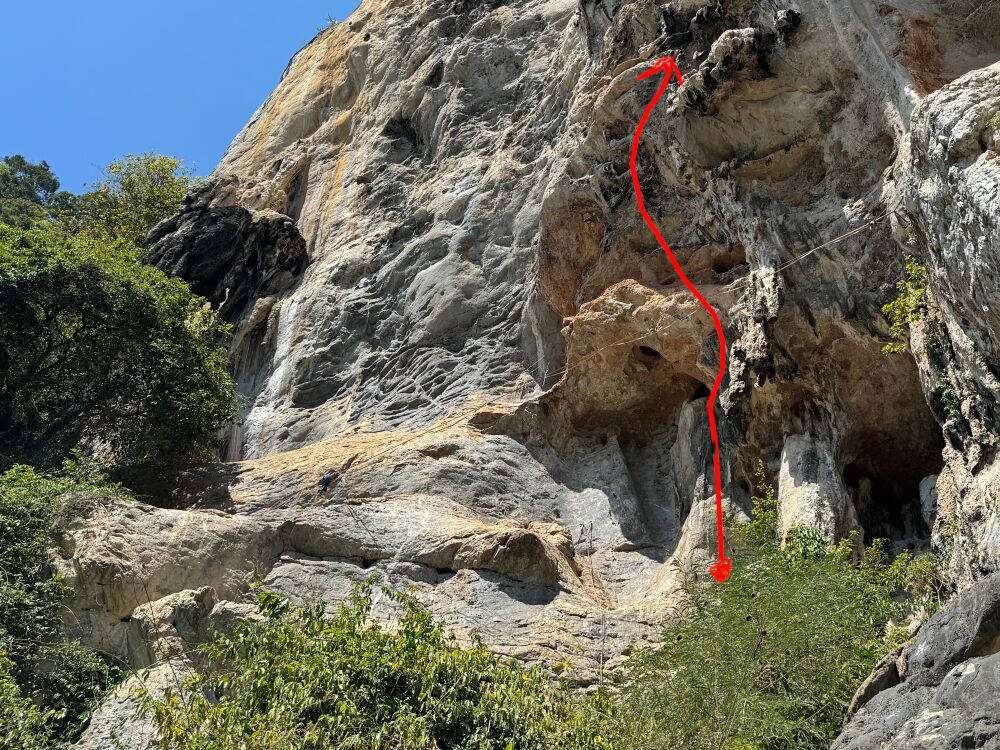
Reaching the base of the route is not particularly difficult. There is a path leading up to Cat Wall right next to the Sunset Bar (what3words location: ///exhorted.poppy.reactor). The path is steep but equipped with access ropes all way up to the base of the crag. The starting ledge of “Heart of Darkness” is located a few meters above the ground (see photo below).
Timing and planning
One of the major challenges is timing the climb. Heart of Darkness is exposed to sunlight until about 12:00 – 12:30 PM (from December to February), and completing the route, depending on the climbers’ skills, team coordination, and the equipment used, can take several hours (or possibly even more). Therefore, it is good to start climbing as soon as the route gets into the shade. An interesting fact is that, due to Cat Wall’s shape, Heart of Darkness finds itself in the shade before the other routes in this sector.
Gear
Standard equipment for sport multi-pitch routes with about 16 quickdraws which should be sufficient for most parties. The choice of ropes is quite crucial.
Rope Management
Other than timing, the other major challenge of Heart of Darkness is safely and quickly descending to the base of the rock. Since the entire route is overhanging, getting down is not as easy as from some other vertical routes.
The last and longest pitch is about 35 meters, so technically it is possible to complete the route with a single 70m or longer rope. However, considering that all the pitches of the route are somewhat overhanging, descending would mean a lot of back-clipping – which is definitely physically tiring and slow.
So, one way to get down is to use a single +70m rope and back-clip every pitch.
By bringing two ropes (one at least 70m and the other at least 60m) and having some experience, it is possible to eliminate back-clipping altogether.
Here is how we did it. The 80m rope was used for belaying, and the end of the loose 60m rope was attached to the second climber’s gear loop. Upon reaching the second belay station (A2), we pulled up the 60m rope to the station and tied its other end to it. The second climber continued to haul the rope – all the way to the fourth station (the rope, along with the climber, passed through the “needle”). We climbed the last pitch in such a way that the first climber lead climbed the pitch and was then lowered to station A4 and then the second climber top-roped the pitch and was subsequently lowered to station A4 (certainly the second climber could have lead climb the pitch as well but we chose top-rope). Once both were back to A4 we tied both ropes together and made a descent from station A4 to A2 without back-clipping (through the “needle”) – this was possible because one of the ends of the 60m rope was attached to station A2, and during the descent, it was possible to pull oneself towards the A2 station by pulling the 60m rope. From station A2, after pulling the ropes, we made a descent straight to the ground.
Other considerations
In some cases, if the second climber falls on some more overhanging terrain, they may not be able to get back to the wall. In such a case, the only option (other than getting external help) is for the second climber to prusik up the rope – so it might be quite important to have the proper gear and skills to jug a rope/ropes.
For parties that do not move quickly, it might be good to consider taking headlamps.
